


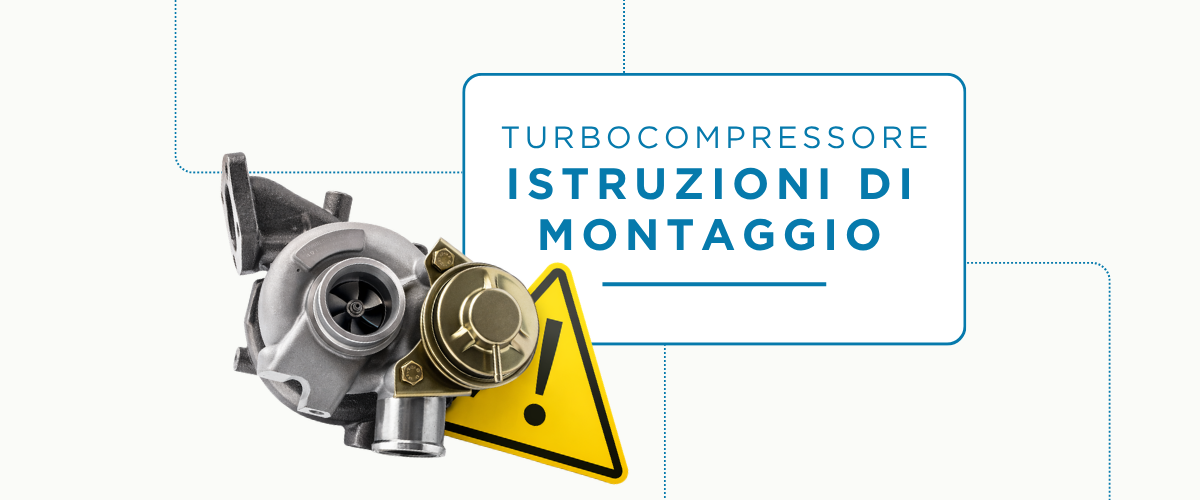
CAUTION BEFORE PROCEEDING
The turbocharger you are replacing has failed for a specific reason. Before installing the new turbo, it is essential to identify and eliminate the problem that caused the previous one to fail. Failure to address the cause may compromise the proper functioning of the new turbocharger and cause premature failure.
In most cases, failure does not occur spontaneously, but is the result of issues related to insufficient or contaminated lubrication, blockages in the ducts, the presence of foreign bodies, or engine system anomalies.
The following instructions are intended to ensure correct installation and maintain the reliability of the turbocharger over time.
Quality Control
The newly purchased turbocharger was:
- Tested on a VSR test bench for vibration and leak testing;
- Tested on a flow bench to check the variable geometry and actuator.
Warranty
The purchased turbine is covered by a warranty, as per the general conditions of sale.
The warranty immediately expires in the event of:
- Tampering of the turbo;
- Removal of the seals;
- Sporting use;
- Damage caused by factors external to the turbocharger;
- Failure to follow the technical instructions below.
INSTALLER INSTRUCTIONS
It is mandatory to replace:
- Engine oil;
- Oil filter;
- Air filter;
- Oil filler hose (especially if flexible);
- Filters on the oil filler hose connections;
- Vapor decantation system.
Carefully check:
- Oil filler hose (if rigid): Must be free of restrictions, kinks, or carbon deposits;
- Oil drain hose: Must not have any kinks or obstructions to proper flow;
- Manifolds, pipes, hoses, and air filter compartment: Must be completely clean of any residue from the previous turbocharger;
- Intercooler: Must be removed and cleaned thoroughly;
- Exhaust system and anti-pollution devices: The muffler, EGR valve, catalytic converter, particulate filter, and all other devices must be free of fouling and carbon deposits.
First start-up procedure
- Run the engine using the starter motor, without starting it, until the oil circuit is pressurized.
- Start the engine and let it idle for the first few minutes.
- Accelerate gradually and in a controlled manner;
- Check the oil pressure with a pressure gauge, according to the vehicle manufacturer’s specifications.
Any abnormal noise or hissing sound indicates a possible malfunction. If this occurs, immediately turn off the engine and proceed with the checks.