


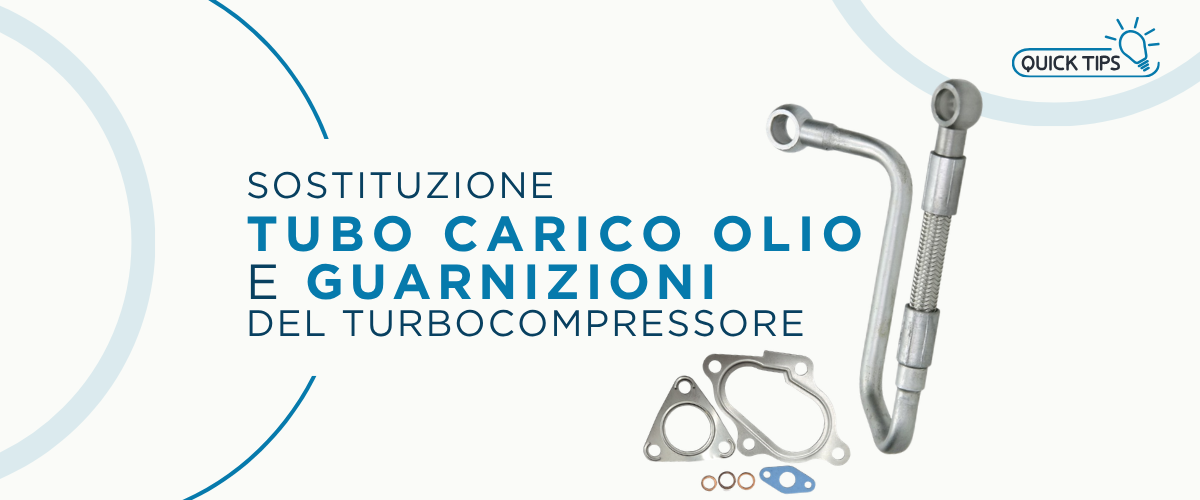
When replacing a turbocharger, attention is often focused exclusively on the core component.
In reality, one of the most critical—and often overlooked—aspects is replacing the oil filler pipe and its gaskets.
Neglecting these components is one of the most common causes of premature failure of a newly installed turbocharger.
Carbon Deposits: The Invisible Enemy
A turbocharger is generally replaced after 100,000–150,000 km.
During this time, carbon residue builds up inside the oil filler pipe, fittings, and any filters.
Once the pipe has been “moved” to remove the turbo, these carbon deposits can be released at any time, even partially obstructing the oil inlet, which normally never exceeds 1.5 millimeters. Even the smallest impurity is enough to cause immediate damage.
The vital role of the oil filler pipe
The oil filler pipe is the direct connection between the engine and the turbocharger, which operates under extreme conditions:
- Very high temperatures
- Rotation speeds that can exceed 200,000–250,000 rpm
To function properly, the turbo relies exclusively on constant and clean lubrication. If this pipe is not in perfect condition, the oil flow will be insufficient or irregular, immediately compromising the turbo’s performance.
The greatest risk in flexible pipes
The situation becomes even more critical when the oil filler pipe is flexible, that is, rubber covered with a steel mesh. Working in close contact with the turbocharger, these pipes are exposed to very high temperatures. Over time, the rubber hardens, loses elasticity, and degrades.
The risk is the release of micro-fragments of rubber into the oil circuit.
Even tiny particles are enough to irreversibly damage the turbo.
The importance of replacing gaskets
In addition to the oil filler pipe, it is essential to replace all gaskets connected to the turbo lubrication system.
Old or warped gaskets can cause:
- Micro-oil leaks
- Pressure drops
- Air leaks in the circuit
All of these factors reduce the effectiveness of lubrication and seriously jeopardize the life of the turbocharger.
Conclusion
At DEPROS, we work daily with turbochargers and their components.
Field experience has shown us that replacing a turbo without changing the oil filler pipe and gaskets is an incomplete repair.
For this reason, DEPROS provides:
- New oil filler pipes, designed to ensure optimal flow rate
- Seal kits, compliant with the lubrication system specifications
This approach allows:
- Protect the turbocharger
- Prevent premature failure
- Ensure a professional and long-lasting service
In the world of turbochargers, the details make the difference. And the lubrication system is one of those details that cannot be ignored.