


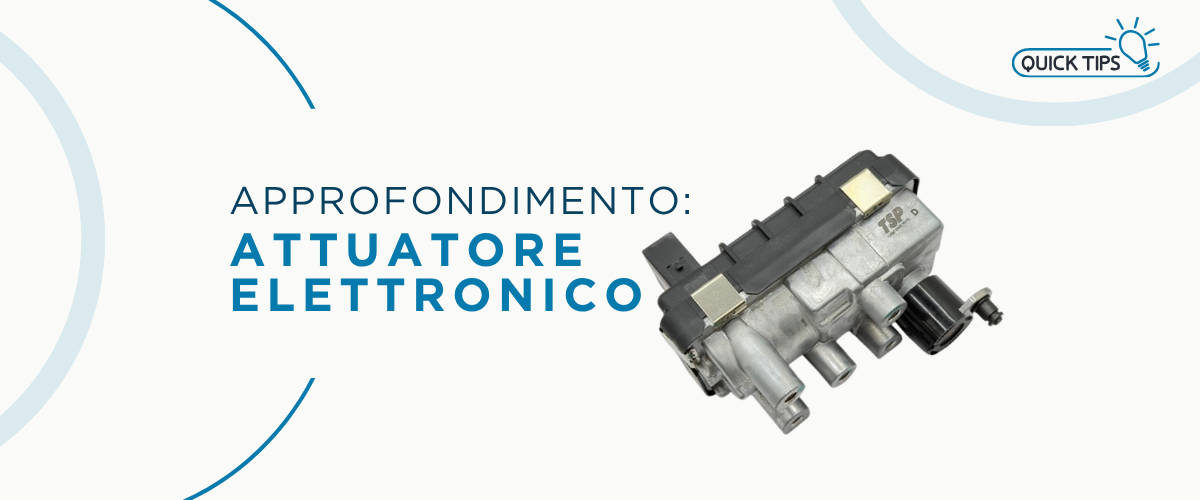
Electronic actuators are one of the most advanced and delicate components of modern turbochargers. Their proper management is essential to ensure engine performance, efficiency, and reliability, but at the same time requires specific skills and in-depth knowledge of the system.
Actuator-related issues are often addressed superficially, without considering the true complexity of these devices and the resulting technical implications.
What is an electronic actuator and what is it used for?
The electronic actuator is a fundamental component of the turbocharger, consisting of:
- An electronic component, which receives signals from the engine control unit
- A mechanical component, which transforms these signals into motion
Through a connecting arm, the actuator regulates the variable geometry of the turbo, modulating the opening and closing of the vanes.
This system optimizes:
- Emissions;
- Fuel consumption;
- Torque and power;
- Overall engine performance.
Types of electronic actuators
Among the most common are actuators manufactured by Hella, often installed on Garrett turbochargers. They are divided into two main categories:
- REA (Rotary Electronic Actuator) → programmable via dedicated instrumentation;
- SREA (Simple Rotary Electronic Actuator) → non-programmable.
This difference is crucial when replacing or repairing.
Because each actuator is “unique”
Each actuator is specific to a single turbocharger. Although aesthetically similar, actuators differ in:
- Arm dimensions and geometry;
- Working angles;
- Internal electronic parameters.
Replacement and recalibration
Replacing an actuator is possible, but with significant limitations.
Any disassembly or replacement requires recalibration using specific tools, performed by qualified personnel.
Without this procedure:
- The turbo may malfunction
- New errors may be generated in the control unit
- The turbocharger may be damaged
This is why a generic request for a “compatible” actuator is not sufficient to guarantee a proper repair.
Aftermarket: focus on quality
In recent years, the availability of electronic actuators has become widespread in the aftermarket. However, it is essential:
- Check the quality of the component
- Rely on reliable suppliers
- Have the installation performed by specialized professionals
An unsuitable or improperly calibrated actuator can compromise the entire turbo system.
Conclusion
Electronic actuators are a highly sophisticated component of the turbocharger.
Understanding their specific characteristics, unique features, and calibration requirements is essential to avoid misdiagnosis and ineffective repairs.